
UNTIL THE END OF THE WORLD
Photography Workshop in Tierra del Fuego
- INFO
- ITINERARY
- PRICE / INCLUDED
- BOOKING CONDITIONS
A Photo Adventure at the End of the World
-
GENRE
Landscape, Wildlife
-
BEST TRAVEL PERIOD
September to February
-
DIFFICULTY
Easy
-
GROUP
Max 9
-
GENRE
Landscape, Wildlife
-
BEST TRAVEL PERIOD
September to February
-
DIFFICULTY
Easy
-
GROUP
Max 9
Traveling to Tierra del Fuego means immersing yourself in untamed wilderness. It is a journey where you can retrace the footsteps of legendary explorers like Ferdinand Magellan, connect with the rich heritage of the native Ona, Yagán, Haush, and Alacaluf peoples, and encounter the incredible wildlife—from penguins to sea lions—that calls this rugged landscape home.
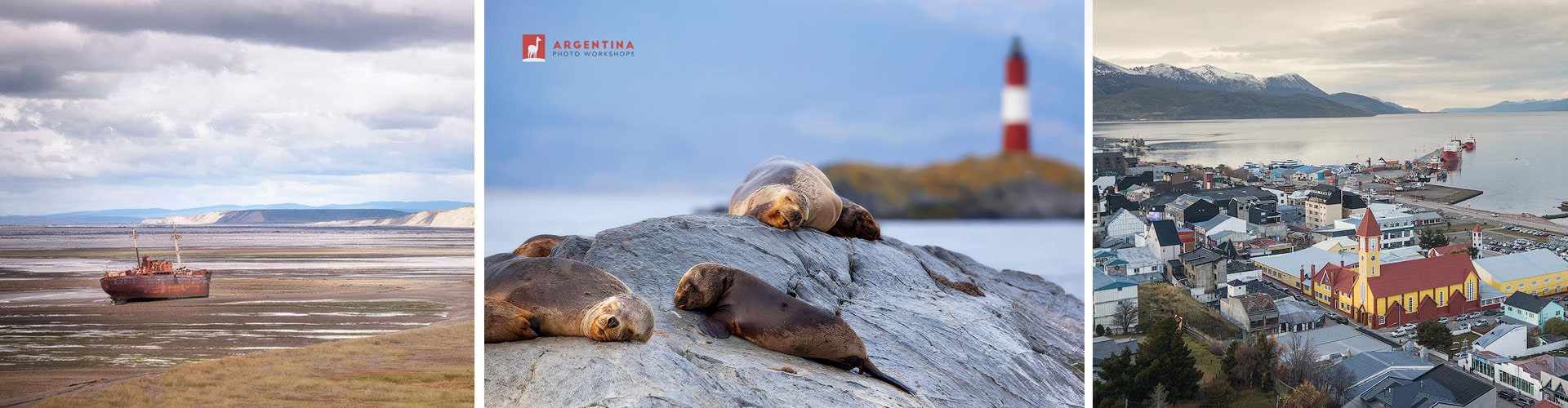
Together, we will sail the historic Beagle Channel, discover the haunting beauty of the Desdemona Shipwreck, and ride the iconic End of the World Train—the southernmost operating railroad on Earth.
Every step of the way, we will chase the region’s best light to capture breathtaking, once-in-a-lifetime photography.

To book flights, please contact us before, we will help you coordinate schedules and transportation to get there. The nearest city is Ushuaia.

Transportation to Tierra del Fuego is not included in the trip, and we will not be responsible for any delays or disruptions that are beyond our control. In any case, we will do what we can, given the circumstances, to help you.
Arrival in Ushuaia. Lodging at the designed hotel.
Afternoon tour exploring the city, until sunset.
Night in Ushuaia.
We will set out before dawn to arrive at Cabo San Pablo just in time to capture the haunting wreck of the Desdemona in the pristine, early morning light.
Afterward, we will take a scenic walk along the dramatic shores of Lake Fagnano. Afternoon and sunset shooting the picturesque town of Tolhuin.
Overnight in Tolhuin.
After breakfast, we will leave Tolhuin to take direction north.
Morning time will be dedicated to exploring the historic structures of Estancia Maria Behety. We will have time to wander through the complex, set up gear, and focus on the architecture.
The primary highlight is the colossal shearing shed, the largest of its kind in the world. We will be able to document its immense interior, focusing on the weathered wood, rusted iron, and high-contrast light piercing through the building’s seams. We will also explore the pioneer-era heritage of the main settlement, capturing the fine details of the old workshops and beautifully preserved houses.
After lunch on-site, the afternoon will give us a deeper dive into the rhythms of this massive, working ranch. The extended stay allows us to observe and photograph the authentic daily life of the local gauchos as they work with horses and manage the livestock. We can also look outward to the landscape itself, capturing the vast, minimalist horizons of the Patagonian steppe and the dramatic curves of the nearby river.
Overnight in Ushuaia.
After breakfast, we will venture into Tierra del Fuego National Park—a protected wonderland where pristine sub-Antarctic forests meet glacial lakes, rushing rivers, and dramatic sea coasts.
During our exploration, we will step back in time aboard the legendary Train at the End of the World, the southernmost operating railroad on the planet.
In the afternoon, we will take a boat tour to explore the Beagle Channel and its unique wildlife.
Overnight in Ushuaia.
After breakfast, we’ll say goodbye until the next adventure!
IMPORTANT
The itinerary published on this page and on our PDFs/brochures is indicative. The guide reserves the right to make changes without prior notice, which may depend on various factors/events such as weather, geography, protests, medical emergencies, etc.
Changes are aimed at ensuring the safety of travelers and the success of the trip, always trying to maintain the proposed activities.
The weather in Tierra del Fuego is famously wild and unpredictable, and changes are entirely beyond our control—it is not uncommon to experience all four seasons in a single day!
Because safety and photographic quality are our top priorities, our daily itinerary must remain flexible. Please rest assured that we will always do everything in our power to adapt, pivot, and maximize every opportunity to keep our planned activities on track.
Price x person (based on 6 participants):
To be defined.
Single Supplement available.
What's included?
- Professional Photographer
- Small Group Size
- Private Transportation
- Analysis of the Work Done
- Accommodation for 4 Nights
- All Excursions and Photography Activities
- All Breakfasts
What's not!
- Transport from your origin point to Tierra del Fuego
- Entrance Tickets to National Parks
- Other meals (lunch, dinner)
- Travel & Medical Insurance (optional, but recommended)
- Personal Expenses
- Tips
Bookings
To book a workshop we ask for 30% deposit of the total.
The workshop balance must be paid 45 days before the start date. You can also pay in cash (USD or euros) upon arrival.
Cancellations & Refunds
For a workshop cancellation, a written notice is required. Please email your request to [email protected].
We acknowledge the commitment involved in attending our workshops and strive to accommodate unforeseen circumstances.
Please review our Cancellation Policy below:
• Cancellation made more than 271 days before the workshop start date: 20% refund of any payments made.
• Cancellation made less than 270 days before the workshop start date: No refund of any payments made.
Please note the following:
• In the event that you are unable to attend, your paid balance will be credited for 1 year (from the date of the cancelled trip) as part of the payment of a workshop of your choice.
If the amount was paid in Argentine pesos, the equivalent in US dollars will be credited subject to the exchange rate on the day the trip was cancelled.
In case the workshop is cancelled by Argentina Photo Workshops due to reasons of force majeure:
• There will be a complete refund of the amount deposited.

5% EARLY BIRD DISCOUNT
Applies to group workshop reservations (not private) made more than 8 months in advance of the start date.
RECOMMENDED EQUIPMENT
Check out our guide on “How to Prepare for a Photography Workshop”, as well as information on equipment and FAQs below.
Near the date of the workshop, we will be in touch through a WhatsApp group, an ideal space to answer all kinds of questions before the trip and organize every detail. If necessary (upon request) we will also arrange a group video call via Google Meet for this purpose.
Although you can participate with any type of photographic device, we recommend a reflex or mirrorless camera, which allow much more freedom and creativity.
Considering the wide variety of photographic situations this workshop presents, it is advisable to have available focal lengths ranging from wide-angle (shorter distances) to telephoto (longer distances).
For Landscape Photography, we suggest a wide focal lenght: ideally around 15 – 50 mm. You can also get a good landscape with a longer focal length by using a stable tripod.
For Night Photography the shorter the focal length, the better. This makes it possible to include more elements in the frame.
For Wildlife Photography, a 300mm or longer telephoto lens is the best choice.
Consider also buying a tele converter to increase the focal length of the lens: 1.4x or 2x. Even if with loss of luminosity.
Finally, choosing the right set of lenses is not easy. If you encounter difficulties and need some suggestions do not hesitate to contact us.
Many of the areas we visit are remote, and it is possible to fly the drone, always maintaining proper precautions and at a distance from agglomerations of people, airports, and helicopter landing strips.
The most important feature of a tripod is its stability. Since every journey includes some trekking, we must also take into account the weight.
We suggest a good carbon tripod that maintains a good balance between weight and stability, that can easily change from one height to another and that locks in little space.
Aluminum is also fine, as carbon is generally much more expensive. We know that choosing a tripod is not easy and we are available to help you choose the right model for you.
A Polarizing filter will be very useful to neutralize water reflections in the lagoons.
For those who love Landscape Photography, ND filters with 6 or 8 steps will be also very useful to play with the movement of water and clouds.
It is recommended to carry UV or Skylight filters, useful to protect the lenses from Ultraviolet rays (even more important in these altitudes), dust and splashes.
Finding the right photo backpack can be a difficult challenge. We recommend you to rely on a brand with quality and experience in the market.
The type of backpack clearly depends on your equipment. But what really matters is that you feel comfortable with it and possibly fitted with a rain cover.
You can’t miss in your backpack: a cleaning kit for the lenses, a remote control to shoot without touching the camera, hood for the lenses (to avoid flare) and a robust / comfortable camera strap.
It is also important to take spare batteries and memory cards with you. In this workshop, we won’t have a chance to recharge our batteries every day.
For those interested in POST-PRODUCTION we suggest bringing your laptop with some editing software already installed. The Lead Photographer, at the end of the day, will answer your questions.
FREQUENTLY ASKED QUESTIONS
Of course, accompanying non-photographers are welcome. The price is the same.
Usually in a Photo Tour the Leading Photographers accompany to locations only, while in a Workshop you are also expected to receive technical notions to improve your photography. Both options, often confusing, are good. It depends on what one is looking for. Our activities are developed in both modes, depending on the trip.
Tierra del Fuego features a distinct blend of marine, coastal, and sub-Antarctic forest ecosystems, making it a spectacular region for wildlife watching. Because the island is isolated from the South American mainland, it has a unique mix of native species—and a notable presence of introduced ones.
Terrestrial Mammals
The island’s forests and peat bogs provide a home for a handful of specialized land mammals, though sightings require a bit of patience.
Guanacos: These elegant, wild relatives of the llama are the largest native land mammals on the island. Because pumas are absent from the main island of Tierra del Fuego, guanacos thrive here peacefully and are frequently spotted grazing in open valleys and on mountain slopes.
Fuegian Red Fox (Culpeo): This is a distinct, larger subspecies of the Andean fox native to the island. Recognizable by their reddish fur on the head and legs, they are curious animals that can occasionally be seen near forest edges.
North American Beavers: Introduced in the 1940s, beavers have fundamentally altered the landscape. While they are destructive to the local ecosystem, you can easily view their massive wooden dams and lodges along specialized paths like the Senda Castorera.
Marine Life & Mammals
The cold, nutrient-rich waters of the Beagle Channel and surrounding oceans support an abundance of marine life.
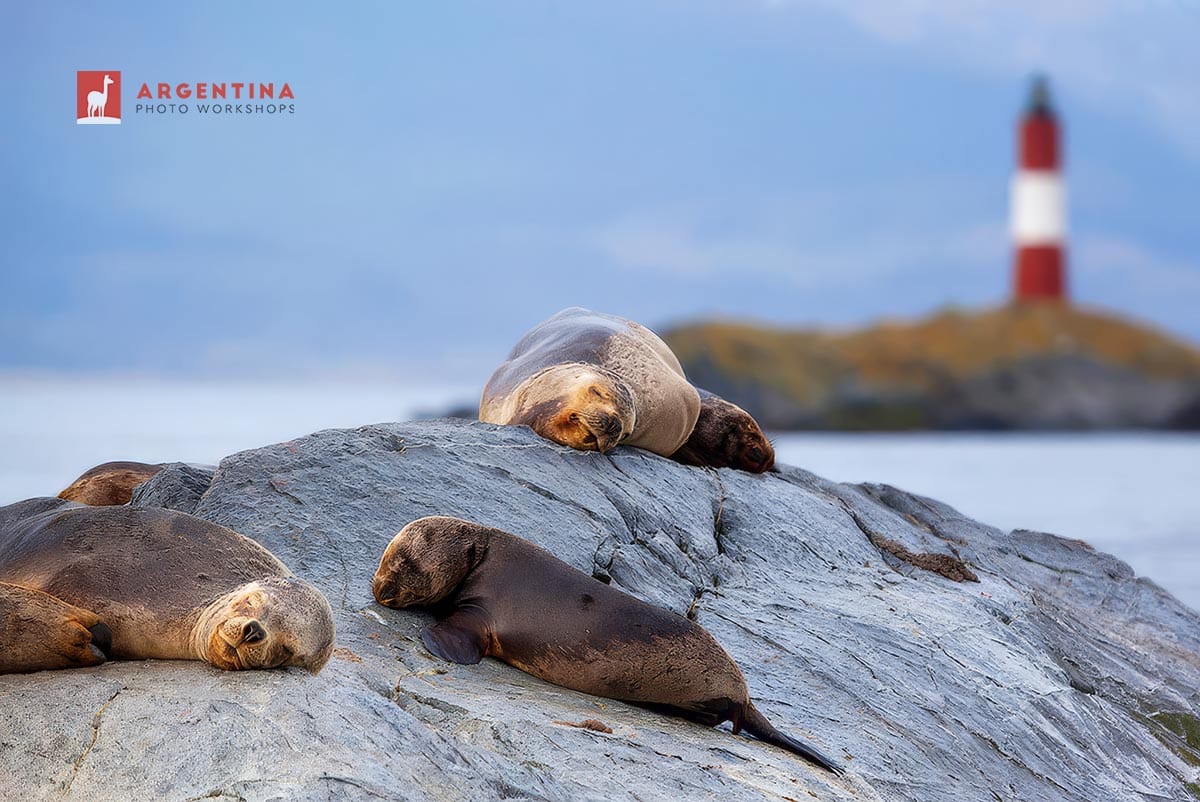
Sea Lions & Fur Seals: Large colonies of South American sea lions gather on the rocky islets of the Beagle Channel. Boat tours from Ushuaia frequently sail close to these colonies, where you can watch them sunbathing or swimming.
Dolphins: Keep an eye on the water when sailing; Peale’s dolphins and the distinctive, black-and-white Commerson’s dolphins are common sights, often riding the bow waves of boats.
Whales: Depending on the season (primarily December to March), humpback whales are occasionally spotted migrating through the deeper channels and fjords.
Avifauna (Birds)
With over 90 recorded species, Tierra del Fuego is a paradise for birdwatchers, especially where the forest meets the sea.
Penguins: Multiple species can be found here. Martillo Island in the Beagle Channel hosts a major breeding colony of Magellanic penguins (which nest in underground burrows) alongside a smaller group of Gentoo penguins. Across the border on the Chilean side at Bahía Inútil, you can find the only continental colony of massive King Penguins.
Andean Condors: The largest flying land bird in the world can frequently be seen catching thermal updrafts, soaring high over the mountain peaks and valleys.
Magellanic Woodpeckers: Living deep within the southern beech forests, these massive birds are striking—the males boast a brilliant, fiery-red head. You will often hear their distinct, heavy double-tap echoing through the trees before you see them.
Waterfowl & Shorebirds: The coastlines and lakes are filled with unique birds like the Kelp Goose, Ashy-headed Goose, Flightless Steamer-Ducks, and Blackish Oystercatchers.
Here is a list of recommended clothing for Tierra del Fuego:
- Waterproof Hiking Boots
- Comfortable Trainers
- Thermal Clothes (T-shirt and underpants)
- Lightweight and breathable long-sleeved shirt and T-shirt for UV protection
- Sunglasses for UV Protection
- Headlamp
- Hat, gloves and neck cover
- Windproof and rainproof jacket and trousers
Tierra del Fuego has a subpolar, maritime climate.
The defining rule of local weather here is unpredictability—you can experience all four seasons in a single afternoon.
The Four Seasons at the End of the World
Summer (December to February): This is the peak travel season. Daytime highs average around 10°C to 15°C (50°F to 59°F). The real highlight is the daylight: you get up to 17 to 18 hours of light per day, with the sun setting past 10:00 PM. However, summer is also the windiest season, with powerful gusts sweeping in off the ocean.
Autumn (March to May): A favorite for landscape photographers. The lenga and guindo forests turn dramatic shades of deep red, orange, and gold. Temperatures drop rapidly, averaging between 2°C and 10°C (35°F to 50°F).The days shorten quickly, and the first snowfalls usually arrive on the mountain peaks by May.
Winter (June to August): The region transforms into a snowy winter wonderland, hosting the southernmost ski resorts on earth. Daytime temperatures hover right around freezing (0°C to 4°C / 32°F to 39°F) and can drop well below -10°C (14°F) at night. Daylight is scarce—only about 7 hours a day.
Spring (September to November): The snow begins to melt in the valleys, wildflowers bloom, and migratory wildlife (like the penguins) start returning to the coasts. Temperatures slowly climb back up to 4°C to 11°C (39°F to 52°F). Like summer, spring can bring sudden, biting winds.
The round trip between your city of origin and Tierra del Fuego is not included in the price.
However, we can help you coordinate it.
These activities require a lot of organization and are prepared well in advance. Weather is a factor we can’t predict, so the workshop/photo tour is not cancelled.
In any case, we will always be attentive to weather conditions to optimize the program and try to provide the best light conditions for photography.
Get more information about the Photo Tour, such as the cost of the next group workshop or a quote for a private adventure, just for you / your group.
GET MORE INFO
Join this Adventure!
RELATED ARTICLES


The Magic of Autumn in Patagonia
Patagonia is the dream of every traveler who ventures into...
Read More