
Photography Tours in the Argentine Mesopotamia
Discover the wetlands, wildlife, and culture of Northeast Argentina during Photography Tours guided by Local Professional Photographers.
The Argentine Mesopotamia is one of the most visually extraordinary regions in South America — and one of the least photographed. Between the Paraná and Uruguay rivers lies a world of vast wetlands, subtropical jungle, colonial ruins, and a living gaucho culture that feels unchanged by time.
Our Photography Tours in the Argentine Mesopotamia are designed for travellers who want more than holiday snapshots. Whether you have a few days or a full week, we take you to the right places at the right light — by boat through the Iberá channels at dawn, beside a gaucho as he herds cattle at golden hour, or face-to-face with a caiman as mist rises off the lagoon.
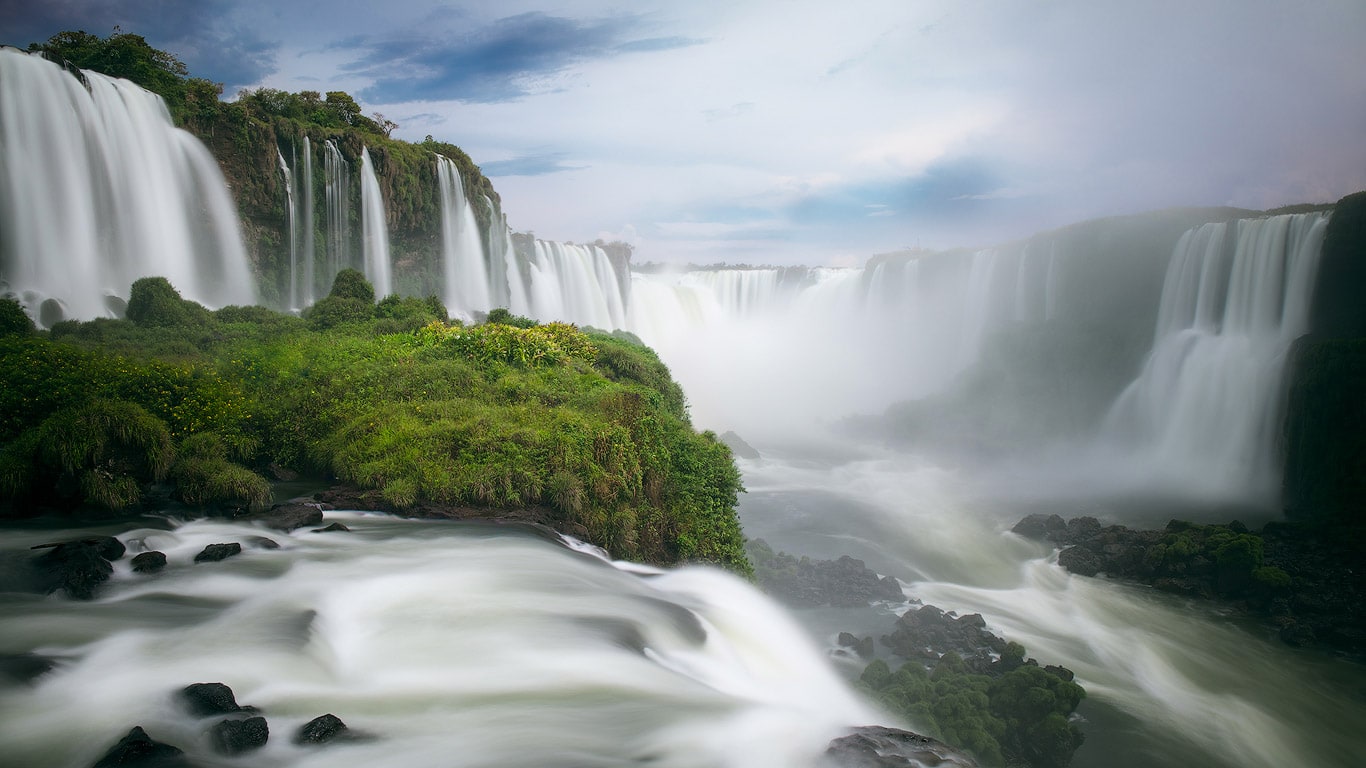
From the immense Esteros del Iberá to the thundering Iguazú Falls, from the Jesuit ruins of Misiones to the carnival streets of Gualeguaychú, the Argentine Mesopotamia never looks the same twice.
Let us show you the version most visitors never see.
ARGENTINE MESOPOTAMIA PHOTO TOURS

Private, Tailor-Made Photo Tours
We put an Experienced Team of Travel Experts, Local and Photography Guides at your disposal to design our Tailor-Made Private Photo Experience.
A Photography Travel Experience entirely focused on your interests, whether it is Nature, Wildlife, People, Architecture, Landscape, Documentary, or Street Photography.
You can choose from any of the Destinations we offer, from Buenos Aires to the Argentine Northwest, the Iberá Wetlands and Misiones, to the remote Patagonia and Tierra del Fuego.
If you have a destination in mind that is not listed on our website, please ask us. We respond quickly.
The APW Signature: Premium Service Add-ons
We elevate your Photography Expedition with services designed for the traveler seeking Comfort, Security, and Exclusivity in Argentina’s most remote corners.

Private 4x4 Transportation
Exclusive mobility in vehicles equipped for rugged terrain, ensuring safe access to remote locations in Patagonia or the Puna.

Curated Accommodations
A handpicked selection of boutique hotels and historic estancias that blend local charm with high-end comfort standards.

24/7 Bilingual Logistics
Full technical and coordination support in both Spanish and English throughout your journey for a completely stress-free experience.
📸 Why the Argentine Mesopotamia for Photography?
The Argentine Mesopotamia Through a Photographer's Eye
The Argentine Mesopotamia concentrates an unusual variety of photographic subjects in one region. Wetlands, subtropical forest, waterfalls, wildlife, Jesuit ruins, gaucho culture, and carnival — each with its own light, its own pace, and its own demands on the photographer. You can spend a morning on a boat in the Iberá photographing caimans and capybaras at close range, and the following day be standing in front of the Garganta del Diablo with a wide angle. Few destinations in Argentina offer that kind of range.
Light
The Mesopotamia rewards photographers who work the edges of the day. Dawn over the Esteros del Iberá is one of the finest natural light experiences in Argentina: mist rising from still water, the first light catching the reeds, the calls of birds breaking a silence that feels absolute. By the time the sun is fully up, the wetland is already transformed — and again at dusk, when the water turns orange and the caimans emerge to the surface. In the jungle of Misiones, light filters through the canopy in shafts — a completely different photographic environment from the open wetlands. The forest rewards photographers who understand how to expose for high contrast and how to find the moments when diffused light makes colour sing.
Wildlife
The Argentine Mesopotamia is one of the great wildlife photography destinations in South America. The Esteros del Iberá alone are home to more than 350 species of birds, as well as caimans, capybaras, giant otters, marsh deer, howler monkeys, and — since the successful reintroduction programme by Rewilding Argentina — the jaguar. Iguazú and Misiones add toucans, tapirs, coatis, and several butterfly species.
Culture & People
The Mesopotamia is not only about nature. The region carries a deep human story: the Guaraní communities of Misiones, the gaucho traditions of Corrientes and Entre Ríos, the Jesuit mission ruins of San Ignacio Miní, and the carnival culture of Gualeguaychú. For portrait and documentary photographers, this is rich, layered, and remarkably accessible territory.
Colour
The palette of the Argentine Mesopotamia is intense: the red earth of Misiones against dense green forest, the silver of the lagoons at dusk, the orange of the Iberá at golden hour, the ochre and terracotta of the Jesuit ruins.

Argentine Mesopotamia Greatest Photography Locations
The Esteros del Iberá: A Nature Photographer's Paradise
The Esteros del Iberá are the heart of any Photography Tour in the Argentine Mesopotamia. This vast system of marshes, lagoons, and floating islands stretches across more than 13,000 square kilometres of Corrientes Province — one of the largest wetland systems in the world, second only to the Pantanal.
For photographers, the Iberá offers something rare: genuine proximity to wild animals in their natural environment. The caimans, capybaras, marsh deer, and birds of the wetland have grown accustomed to the presence of small boats and are remarkably approachable. You can photograph a caiman from two metres, observe a family of capybaras at the water’s edge in the evening light, or watch a jabiru stork take flight against a golden sky.
The most touristic base in the Iberá is Colonia Carlos Pellegrini, a small, quiet village on the shore of the Iberá Lagoon. The village has a number of excellent, locally run lodges with direct access to the water. Dawn boat excursions are the highlight: navigating the narrow internal channels in near silence, surrounded by an extraordinary density of birdlife.
The jaguar — once extinct in the region — has been successfully reintroduced in the Iberá by the Rewinding Argentina Foundation, and sightings are increasingly reported. A jaguar encounter in the Mesopotamia is now a genuine possibility, not merely a dream.

The Jesuit Mission Ruins of Misiones for Photographers
The Jesuit Mission Ruins of Misiones are one of the most singular architectural subjects in South America — and one of the most photogenic. Between the 17th and 18th centuries, the Jesuits built a network of reductions deep in the Misiones jungle that housed tens of thousands of Guaraní people. What remained after the expulsion of the order in 1767 are red sandstone ruins that the jungle slowly reclaimed over two centuries. Today, that process of natural recovery is part of what makes them so extraordinary to photograph.
The most important and best-preserved reduction is San Ignacio Miní, declared a UNESCO World Heritage Site. The church walls, cloisters, and former Guaraní dwellings are built from an intensely reddish sandstone that changes completely depending on the time of day. At dawn, the stone absorbs the low, warm light and returns it with an almost orange tone. At dusk, long shadows define the texture of the carved blocks and the bas-reliefs that decorate the facades — a unique mix of Christian iconography and Guaraní motifs that exists nowhere else in the world.
For the photographer, the key moment at San Ignacio is the opening of the park, when there are still no visitor groups. The raking early morning light on the church facade is one of the best architectural photography opportunities in Argentina.
Beyond San Ignacio Miní, Misiones has other less-visited reductions that offer a different photographic experience. Santa Ana and Loreto are partially overtaken by vegetation, with trees growing between the walls and roots embracing the stone blocks. They are ruins in a more advanced state of abandonment — harder to walk through, but photographically rawer and more surprising.
Santa María la Mayor, in the south of the province, is the least visited of all and allows you to photograph the ruins in a solitude that the others no longer have.
Our photography tours at the Jesuit Missions combine visits timed for the best light with movement between different reductions, making the most of what each site has to offer. For those who want to go deeper, we can arrange night visits to San Ignacio Miní during the months when the park offers light shows — a photography opportunity completely different from anything available during the day.
Photography Tours in the Argentine Mesopotamia: Iguazú and Misiones
Iguazú Falls need no introduction — but they do need a strategy. The falls are extraordinary, and they have been photographed millions of times. The challenge for the serious photographer is to find an approach that goes beyond the obvious.
Our Photography Tours at Iguazú include visits timed for the early morning, when the park opens and the crowds are thin. The Garganta del Diablo is most dramatic at this hour: the mist catches the first light, rainbows form and dissolve, and the roar of the water is the only sound. We also explore viewpoints that most visitors pass quickly — lower catwalks, riverside positions, and, for those with longer lenses, angles that reveal the full scale of the falls from across the river.
Beyond the falls, the Misiones Atlantic Forest is one of the most biodiverse ecosystems in South America. A private reserve near Iguazú gives access to macro photography opportunities — orchids, insects, reptiles, and birds — that the main park simply cannot offer.
The Jesuit Mission of San Ignacio Miní, a UNESCO World Heritage Site, is another extraordinary photographic subject: the red sandstone ruins of a 17th-century Jesuit reduction, partially reclaimed by the jungle, at its most atmospheric in the late afternoon light.
Photography at the Estancias of Corrientes
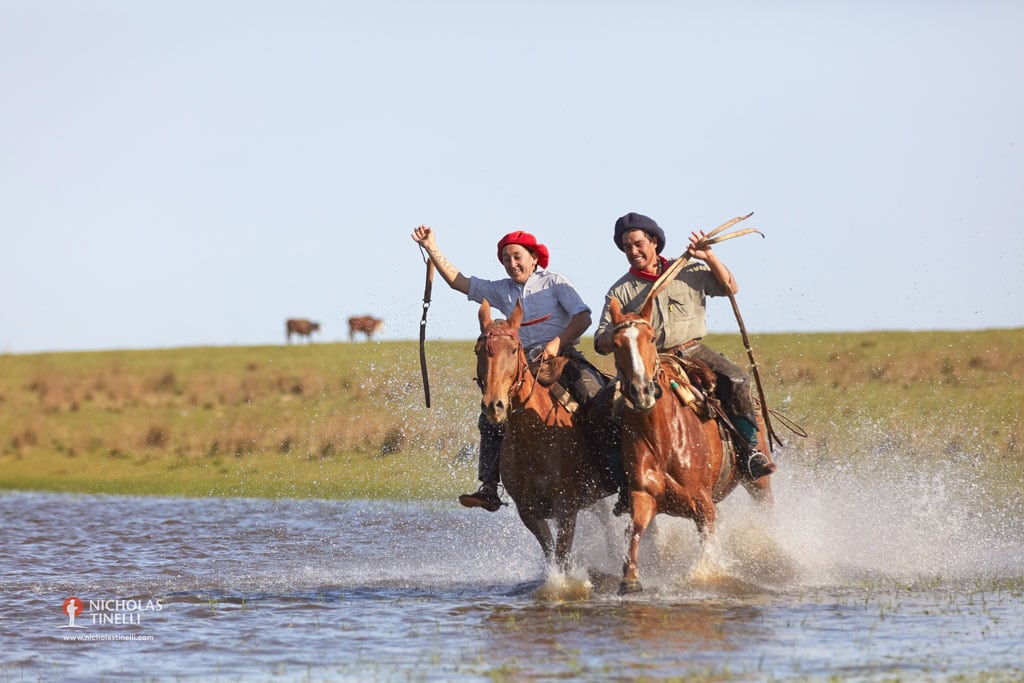
Corrientes Province has a cattle ranching tradition that goes back centuries, and the estancias of the region are unlike anything you will find in the Pampas. Here, the land is wet. The pastures are crossed by streams and lagoons, and the gauchos who work them do so on horseback through water, herding cattle across a landscape that is part grassland, part wetland.
For photographers, this creates a very specific and unusual set of images. The herding scenes — horses moving through shallow water, cattle gathered at the edge of a lagoon at golden hour, a gaucho silhouetted against an open sky — are the kind of photographs that are difficult to find anywhere else in Argentina.
The Estancias of Corrientes are also working farms, not tourist reconstructions. The people you photograph are doing their actual jobs. That authenticity comes through in the images.
A typical photography day at a Corrientes estancia begins before sunrise. The morning light on the wetland pastures is exceptional — low, warm, and long. The main herding activity happens in the early hours, which aligns well with the best light of the day. By mid-morning the work slows, and there is time to photograph the estancia itself — the buildings, the horses in the corral, the daily routines of the people who live and work there.
We work with one of the oldest estancias in the province, with direct access to lagoons and open pasture. Group size is kept very small to avoid disrupting the animals and the work of the farm.
Photography Expeditions at the Yabotí Biosphere Reserve
The Yabotí Biosphere Reserve is the largest protected area in Misiones and one of the best-preserved stretches of Atlantic Forest in Argentina. With more than 250,000 hectares of intact subtropical jungle, Yabotí is the territory of the region’s most elusive species — tapir, jaguar, maned wolf, toucan — and a photography destination that very few visitors know exists.
For photographers, Yabotí offers something that Iguazú National Park, with its tourist infrastructure, can no longer provide: real solitude inside the forest. Trails are scarce and access is limited, which means that those who make it there have the place almost entirely to themselves. The jungle in Yabotí is not managed for visitors. That comes through in the images.
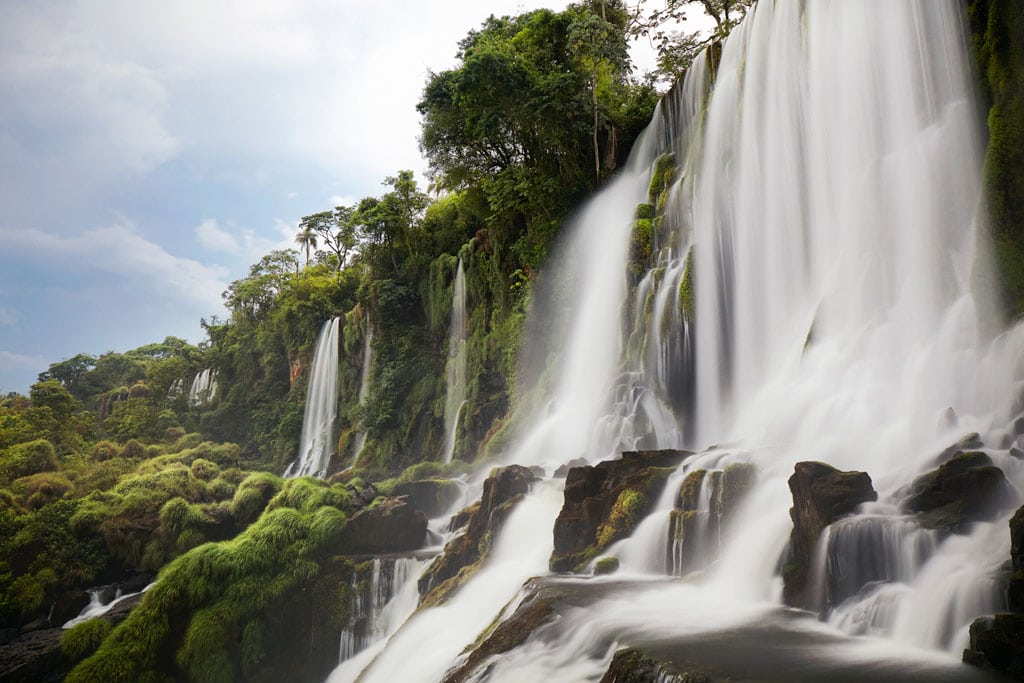
The Yabotí river and the Cuñá Pirú stream run through the reserve and offer specific photographic possibilities: reflections on still water, fishing birds, vegetation falling over the banks. The waterfalls in the interior — among them the Salto Encantado, within the provincial park at the edge of the reserve — are visually powerful photographic subjects, especially on overcast days when the light is soft and even.
Flora photography in Yabotí deserves special mention. The Atlantic Forest of Misiones has an extraordinary density of plant species — orchids, tree ferns, bromeliads, lianas — and the light filtered through the canopy creates conditions for detail photography that cannot be found in any other environment in Argentina.
Access to Yabotí requires planning and a local guide. We handle all logistics, including permits, transport, and accommodation inside or on the edges of the reserve. Groups are kept very small — in some cases two or three people — to minimise impact and maximise the chances of wildlife encounters.
Culture and Identity: The Human Story of the Mesopotamia
Photography Tours in the Argentine Mesopotamia are not only about nature. The region has a culture as rich and distinctive as its landscape.
Chamamé — the folkloric music of Corrientes, declared Intangible Cultural Heritage of Humanity by UNESCO — is deeply embedded in the life of the province. Festivals and local dances are genuine community events, not tourist performances.
The gaucho tradition of the Mesopotamia is different from that of the Pampas — here, the gaucho works in the wetlands, herding cattle between lagoons on horseback, navigating a landscape that is partly land and partly water. It is a photographic subject of extraordinary character.
Gualeguaychú Carnival, in Entre Ríos, is the largest and most spectacular carnival in Argentina — comparable in energy and visual intensity to any carnival in South America. For photographers, it offers a combination of movement, colour, low light, and human emotion that is technically demanding and visually extraordinary.
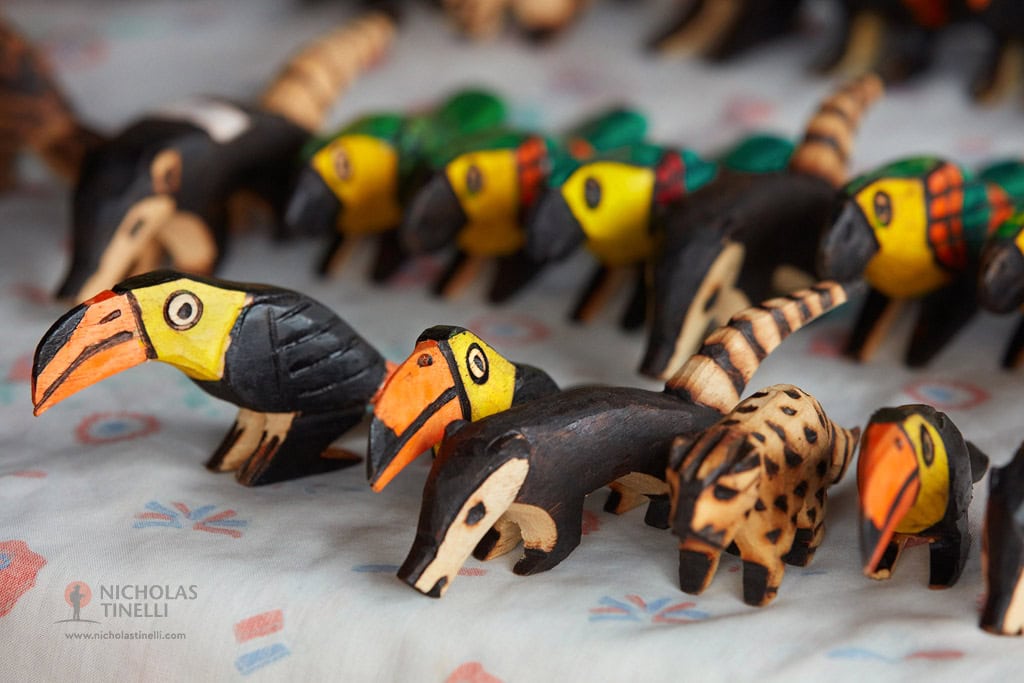
The Guaraní heritage of Misiones adds another layer: communities who maintain weaving, woodcarving, and oral traditions that reach back centuries before the arrival of the Jesuit missionaries. Portrait photography here, done with respect and care, can produce some of the most compelling images of any Photography Tour in Argentina.
Practical Tips for Photography Tours in the Argentine Mesopotamia
Best Time to Visit: Spring (September–November) and Autumn (March–May) for ideal weather and light. Summer for carnival. Winter for concentrated wildlife in the Iberá.
Getting There: Flights to Posadas (Misiones), Corrientes, or Puerto Iguazú connect to the main photography destinations. Buenos Aires is the usual starting point for international travellers. Internal flights or a well-planned driving route are recommended given the distances involved.
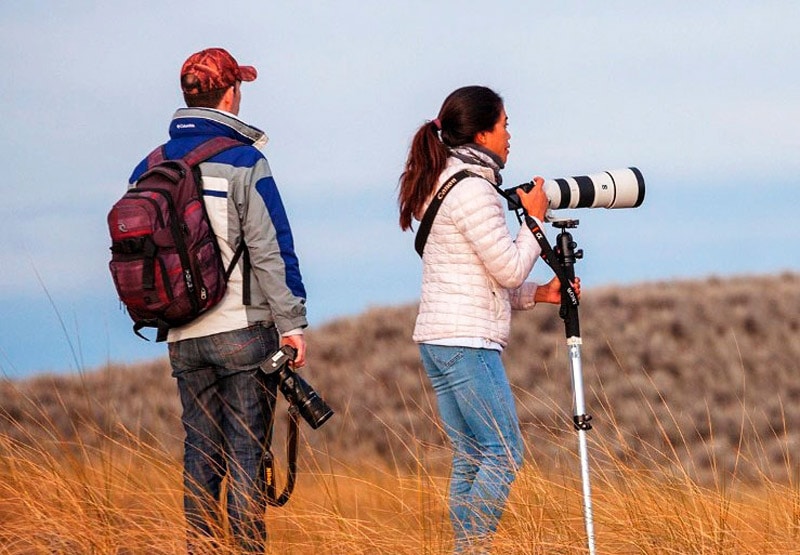
Equipment: For wildlife in the Iberá, a telephoto lens (300–500mm) is a considerable advantage. For macro in Misiones, a dedicated macro lens and a tripod. For the falls and architecture, a wide angle (16–24mm). A waterproof bag or cover is advisable — the Iberá and Iguazú involve constant proximity to water.
What to Expect: Our photography tours are led by local professional photographers who know the Mesopotamia in depth. Group sizes are kept small — a maximum of 9 participants — to ensure genuine access to wildlife, flexibility of movement, and personal attention to your photography.
Photography Tip: In the Iberá, always keep your camera ready before getting into the boat — wildlife encounters happen quickly and without warning. At Iguazú, arrive when the park opens and go directly to the Garganta del Diablo before the first tour groups arrive. In Misiones, the best macro light is in the first two hours after sunrise.

Photography Tours in the Mesopotamia
Frequently Asked Questions
Not at all. Our photography tours in the Argentine Mesopotamia are designed to work for every level — from complete beginners who simply want to take better travel photographs, to working photographers looking for local access and insider knowledge of the light.
We adjust our guidance entirely to whoever is with us. Some clients want technical instruction; others want to be positioned correctly and left to work. We read the group and respond accordingly. The only goal that stays constant is that you go home with images you’re proud of.
Mixed Group Tours bring together between 3 and 9 photographers.
Private tours are just your group — your own pace, your own guide, no one else’s schedule to follow.
Whatever you have.
Our job is to help you get the most out of the equipment you already own. For wildlife, a telephoto lens is a considerable advantage — but it is not a requirement for joining.
Yes. The region is safe and welcoming to visitors. We know the area in depth — the best routes, the trusted local guides, the accommodation, and the conditions at each season. Your wellbeing is part of what we plan for.
Yes, and we enjoy it.
We have run photography experiences for groups ranging from two people to full photography clubs, travel journalists, and corporate teams.
Larger groups require more planning — multiple guides, staggered positions, coordinated logistics — but the result, when it works, is something special.
Send us your group size, your travel dates, and your collective interests, and we’ll put together a detailed proposal.
Book a Photo Tour in the Mesopotamia!
Tell us about your trip — where you want to go, when you can travel, what you want to photograph — and we’ll reply you as soon as possible with a personalised itinerary and quote. All tours are private. All programmes are flexible. The only fixed point is the quality of the experience we build for you.