
Photography Tours in Patagonia
Enjoy incredible Photography Tours in Patagonia, the southernmost edge of the world. We’ll make sure we’re in the right place to capture the perfect light.
There is a particular quality to the light in Southern Patagonia that photographers travel across the world to find. Argentine Patagonia is one of the most photogenic environments on Earth, and one of the most challenging for the unprepared visitor.
Our mission is simple: to design the ultimate Photography Tours in Patagonia and put you in front of the region’s most spectacular light. You won’t be traveling with a standard tour operator; you’ll have a dedicated Photographer in Patagonia by your side who knows exactly how this unpredictable environment behaves.
As passionate Patagonia Photographers, we built these journeys from the ground up to ensure you bring home the shots of a lifetime.

Throughout the year, we organize several group excursions, but we also offer the option of arranging Private Tours. This way, each itinerary is tailored to your travel dates, your fitness level, and what you truly want to take away from the experience.
PATAGONIA PHOTO TOURS & WORKSHOPS
Gauchos in Patagonia

Private, Tailor-Made Photo Tours
We put an Experienced Team of Travel Experts, Local and Photography Guides at your disposal to design our Tailor-Made Private Photo Experience.
A Photography Travel Experience entirely focused on your interests, whether it is Nature, Wildlife, People, Architecture, Landscape, Documentary, or Street Photography.
You can choose from any of the Destinations we offer, from Buenos Aires to the Argentine Northwest, the Iberá Wetlands and Misiones, to the remote Patagonia and Tierra del Fuego.
If you have a destination in mind that is not listed on our website, please ask us. We respond quickly.
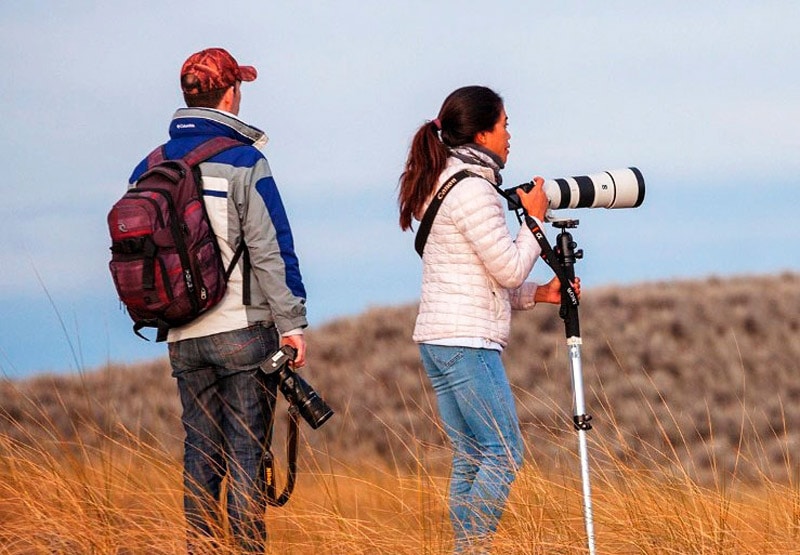
The APW Signature: Premium Service Add-ons
We elevate your Photography Expedition with services designed for the traveler seeking Comfort, Security, and Exclusivity in Argentina’s most remote corners.

Private 4x4 Transportation
Exclusive mobility in vehicles equipped for rugged terrain, ensuring safe access to remote locations in Patagonia or the Puna.

Curated Accommodations
A handpicked selection of boutique hotels and historic estancias that blend local charm with high-end comfort standards.

24/7 Bilingual Logistics
Full technical and coordination support in both Spanish and English throughout your journey for a completely stress-free experience.
📸 Why Patagonia for Photography?
Adventures led by a Local Photographer in Patagonia
The remote, vast landscapes of wild Patagonia are captivating and draw in travelers seeking to escape the daily grind and eager for adventure. From the first light of dawn on Fitz Roy to the final song of the whales in the bays of Valdés, it demands your full attention—and rewards you in equal measure. That’s why photographers keep coming back.
Light
Patagonia sits between 40° and 55° south latitude, which means the sun follows a low arc across the sky year-round — even at the height of summer. In practical terms, that gives you a Golden Hour that lasts closer to 90 minutes at each end of the day in December, with warm, angled light that hits the landscape horizontally rather than from above. In Autumn, the sun stays low enough that that quality of light persists for most of the shooting day, not just the first and last hour. When a storm passes through — and they move fast in Patagonia, often clearing within an hour or two — the sky behind it tends to be exceptionally clean, and the contrast with whatever colour is on the ground beneath it can be dramatic. It is one of the reasons experienced photographers often prefer to wait out bad weather rather than pack up and leave.
Wildlife
Patagonia is one of the few places on Earth where you can photograph large marine mammals, colonial seabirds, apex predators, and vast herds of native ungulates — all in the wild, all in a single trip. Southern Right Whales breach in sheltered bays you reach by zodiac. Orcas hunt sea lions on open beaches while you watch from metres away. Magellanic penguins nest in colonies of hundreds of thousands, indifferent to your presence. Andean condors ride thermals over glacier valleys. Guanacos move across the steppe in their hundreds at dusk. This is not a zoo. It is one of the last genuinely wild coastlines on the planet.
Landscape Diversity
No other region in Argentina — possibly in South America — compresses so many visually distinct environments into one accessible territory. Calving glaciers and iceberg-filled lakes in Los Glaciares. Knife-edge granite spires rising above ancient beech forests in El Chaltén. Volcanic craters and mineral waterfalls in Neuquén. Petrified Jurassic forests on the Santa Cruz steppe. Penguin colonies and whale nurseries on the Atlantic coast. Each landscape demands a completely different photographic approach — and rewards it differently.
Scale and Distance
The hardest thing to convey about Patagonia before you've been is the scale. The landscapes are not just large — they are proportioned in a way that makes the human figure, and the human eye, feel appropriately small. Many of the most spectacular locations are also among the least visited: the correct trailhead, reached at the right hour, puts you alone in front of scenery that most people will only ever see in a photograph. That is not an accident. It is one of the things we spend years learning — and one of the things we pass on to every group we take out.
Colour
If there is a single quality that consistently surprises first-time photographers in Patagonia, it is the colour. The deep, almost unreal turquoise of glacial meltwater against grey moraine. The burning copper-red of an autumn lenga beech forest under low afternoon sun. The chalky white of a whale's underside turning in clear green water. The rust-orange of volcanic rock around the Agrio Waterfall. The near-black of basalt cliffs against an ice-blue sky.
The Weather
The famous Patagonian wind and its habit of producing four seasons before lunch is frequently cited as the region's main challenge. For landscape photographers, it is one of its greatest gifts. Fronts move through fast — a storm that arrives at breakfast can clear by mid-morning, leaving behind charged air, rainbow light, and a landscape that looks nothing like it did an hour ago. The key is knowing where to be when the sky clears. That knowledge is what a guide is for.

Patagonia's Greatest Photography Locations
El Chaltén & Fitz Roy
Fitz Roy does not reveal itself easily. The mountain spends most of its time wrapped in cloud — which makes the moments it clears all the more electric. At dawn, when the first light of the day strikes the granite towers and turns them from grey to pink to blazing orange in a matter of minutes, you understand immediately why photographers plan entire trips around a single morning on Laguna de los Tres.
The classic approach hikes to the Mirador Torre or Laguna Capri takes around four hours each way — which means leaving in darkness, headtorch on, to be in position before the alpenglow begins. It is one of the most physically demanding photographic experiences we offer, and one of the most unreservedly worth it.
Laguna Torre, by contrast, is lower, less visited, and offers a completely different relationship with Cerro Torre — often partially hidden in cloud, which creates compositions of extraordinary atmosphere and mystery.
Autumn (March–April) is when we most often recommend El Chaltén. The lenga beech forests surrounding the trails transform into a wall of copper, amber and red. The tourist season thins. The air carries the particular clarity of the southern autumn. The light, staying low all day, does things to the landscape that summer — for all its long hours — cannot match.

Perito Moreno & Los Glaciares
Perito Moreno is one of the most photographed glaciers in the world — and standing in front of it, it becomes immediately clear why. Watching a tower of blue-white ice the height of a seven-storey building break free and crash into the lake below is not something you forget. And it happens multiple times a day.
The photographic challenge is learning to read the glacier’s rhythm. Calving events are random, but certain sections of the face are more active than others. The morning light — which falls on the south-facing ice face in the early hours — turns the surface into a study in blue: ice blue, sky blue, water blue, all slightly different, all shifting as the light angle changes. We know where to stand, and when to wait.
Beyond the famous viewpoints, Los Glaciares National Park contains some of the most remote terrain in Patagonia. Estancia Cristina, reached by a two-hour boat crossing of Lago Argentino past icebergs the size of houses, sits beneath the Upsala Glacier. The journey there and back is itself a strong photography experience — the scale of the lake, the floating ice, and the surrounding peaks make it worth the time before you even arrive.

Valdés Peninsula & the Atlantic Coast
Wildlife photography is, at its core, about patience and proximity. The Valdés Peninsula offers both in remarkable measure. Between June and October, Southern Right Whales come into the sheltered bays of Golfo Nuevo and Golfo San José to give birth and nurse their calves.
You can photograph them from small boats at distances that would be restricted in most whale-watching destinations — close enough to hear them breathe, to see the barnacles on their backs, to watch the calves roll in the water beside their mothers.
The peninsula’s wildlife extends far beyond the whales. Orcas hunt sea lions on the open beach at Punta Norte in an act of predation so spectacular that the BBC has filmed it multiple times — and it still happens, on the right tides, every year.
Magellanic penguins at Punta Tombo nest in colonies of nearly half a million birds. Elephant seals haul out in enormous piles on beaches you can approach on foot. The photography here is relentless — you rarely have time to review what you’ve shot before something else demands your attention.
We recommend Puerto Madryn as a base and a minimum of three full days on the peninsula. The whale season from June to October is the key window — though spring and summer offer the penguin nesting season and the orca hunts at their most frequent.

Caviahue & the Agrio Waterfall
Ask most photographers who have visited Patagonia about Caviahue, and they will look at you blankly. That is not because it is unremarkable — it is because almost nobody goes.
The Agrio Waterfall is one of the most visually disorienting places in Argentina: a cascade plunging over ancient basalt cliffs stained rust-red and burnt orange by iron deposits, into a churning pool whose colour shifts from emerald to electric blue depending on the angle of light and the mineral load of the water that day.
The surrounding landscape compounds the strangeness. Araucaria trees — the prehistoric monkey puzzle — stand in the middle distance like sentinels from a different geological era. The cone of Copahue volcano smokes on the Chilean border. A crater lake of sulphurous yellow-green water sits at altitude above the village, accessible by 4×4 in summer. Nothing in Patagonia prepares you for it.
It is possible to combine Caviahue with the thermal springs at Copahue, the volcanic steppe, and the araucaria forests of the Pehuén region. For photographers looking to work beyond the established itineraries, this is a place we recommend.

Bariloche & the Seven Lakes
San Carlos de Bariloche sits at the northern gateway of Patagonia and rewards the photographer who gives it proper time. The Nahuel Huapi National Park is one of the most scenically varied in Argentina: deep glacial lakes, native beech and coihue forests, Andean peaks reflected in water of extraordinary clarity.
The Seven Lakes Route, running 108 kilometres between San Martín de los Andes and Villa La Angostura, is one of the great drives of South America and one of the great photography routes. Each lake — Lácar, Machónico, Falkner, Villarino, Escondido, Correntoso, Espejo — has its own colour, its own microclimate, its own relationship with the surrounding peaks. In autumn, the reflected palette of copper and gold in the still morning water takes most photographers completely by surprise.
The single most important viewpoint in the Bariloche area is Cerro Campanario — a short chairlift from the road, and a view at the top that encompasses lake, forest, mountain and sky in one composition. Arrive before sunrise. The light comes first to the peaks and then floods the valley — and the moment it reaches the water is exactly when you want to be pressing the shutter.

Petrified Forests & the Patagonian Steppe
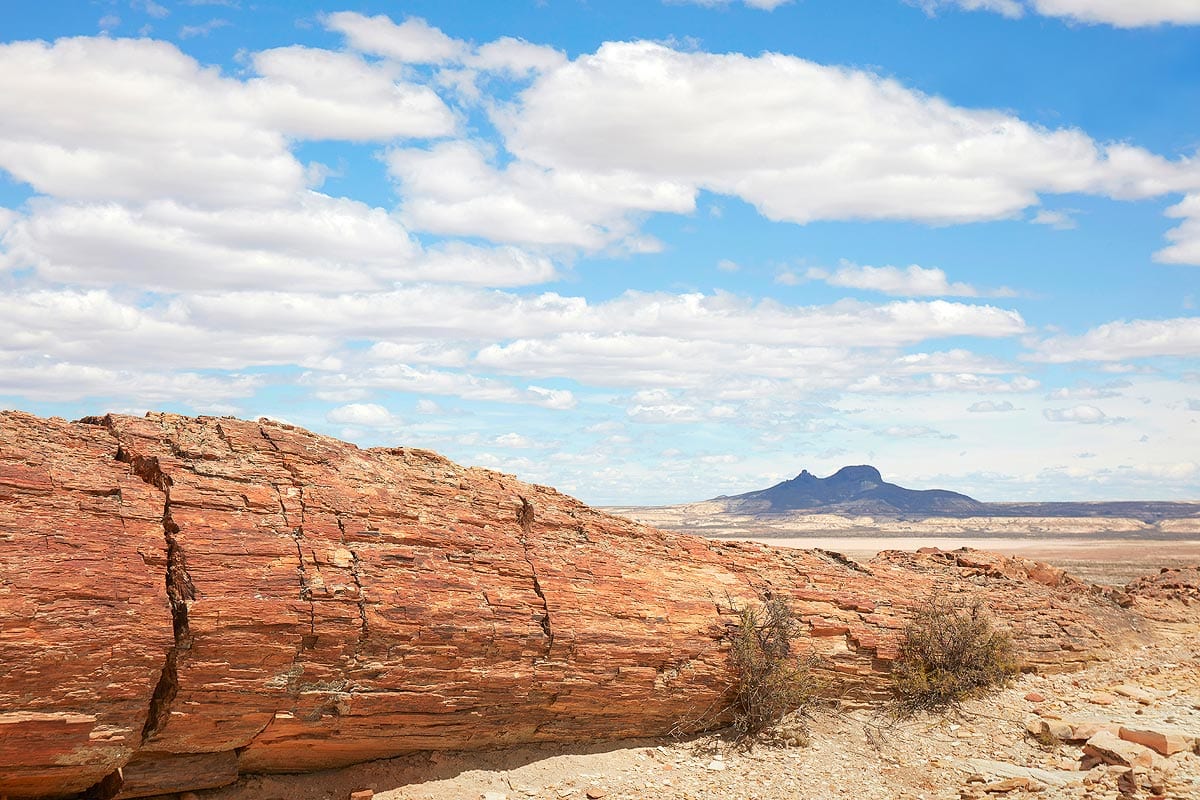
The Jaramillo National Park is one of the most unusual photography destinations in South America. Fossilised araucaria trunks, some over three metres in diameter, lie scattered across an open steppe as if a forest simply fell over and turned to stone — which is, more or less, what happened. 150 million years ago, volcanic eruptions buried a vast Jurassic forest under ash.
Over millennia, mineral-rich groundwater replaced the wood cell by cell, until what remained was rock in the shape of trees. The result is eerie, beautiful, and completely unlike anything else you will photograph in Argentina.
The broader Patagonian steppe is a landscape that most visitors drive through to get somewhere else. That is a mistake. The rolling plateaus, the unbroken horizons, the way the wind bends the grasses in constant motion — and above all, the quality of the steppe light at dusk, when the last sun turns the entire plain the colour of old copper — these are photographic conditions that reward slow travel and genuine attention.
Guanacos move through in loose herds. At night, with no light pollution for hundreds of kilometres, the Milky Way is as clear as anywhere in the southern hemisphere.
Best Seasons for a Photography Tour in Patagonia ☀️
Patagonia is not a destination with one best season. It is a destination with four completely different seasons, each of which is the right one — depending entirely on what you want to photograph.
Summer (December to February) — Long Days, Maximum Access
Summer gives you the most usable hours of any season — in El Chaltén, sunrise comes before 6am and the sky holds colour past 10pm. Every trail is open, every glacier is accessible, and wildlife is active across all regions. The trade-off is volume: summer draws the most visitors, and the most popular viewpoints can be crowded by mid-morning. Book early, start earlier.
Autumn (March to May) — Peak Colour, Near-Perfect Light
Our favourite If we could only take people to Patagonia in one season, this would be it. The lenga beech forests in and around El Chaltén turn copper, amber, gold and red — and the low, warm angle of the autumn sun stays with the landscape from morning to late afternoon. Fewer visitors, cleaner air, and the kind of colour palette that makes even average compositions look extraordinary. March and April, specifically, are when the magic happens.
Winter (June to August) — Whales, Snow & Solitude
Winter on the Atlantic coast is peak season for whale photography — Southern Right Whales begin arriving at Valdés Peninsula from June, and the bays stay full through August. The mountain regions are a different matter: snow closes the higher trails, Bariloche shifts into ski mode, and the steppe takes on a stark, monochrome beauty that rewards photographers who prefer isolation over convenience. The tourists are largely absent. The light, when it comes, is extraordinary.
Spring (September to November) — Wildflowers, Wildlife & Wild Skies
Spring is Patagonia at its most volatile — and for the landscape photographer, that is rarely a bad thing. The valleys below Fitz Roy come alive with wildflowers as the snow retreats. Penguin colonies at Punta Tombo return to full life by October. And the spring storms — which can roll in and clear in under an hour — generate the kind of turbulent skies that the rest of the year only occasionally provides.
Photography Tips for Patagonia 📸
01. Protect Your Gear from the Wind
The Patagonian wind is not an inconvenience. It is a force. A tripod with a camera on top can be blown over on an exposed ridge — and it will happen without warning.
Work low, spread the legs wide, hang weight from the centre hook, and keep your lens cap on every moment you are not actively shooting. A good rain cover for your bag is not optional down here. Neither is a spare camera body if you can manage it.
02. Get There Before the Light Does
The most spectacular moments in Patagonia — particularly the alpenglow on Fitz Roy — happen fast and without a second chance.
Laguna de los Tres from El Chaltén is a four-hour hike each way, which means the alarm goes off at 1am in summer if you want to be in position before the first colour touches the granite. We plan every itinerary around these windows — the rest of the day is yours to recover, review, and explore.
03. Carry More Batteries Than You Think You Need
Cold air is the enemy of battery life, and Patagonia — even in summer at altitude — can be cold enough to halve the number of shots you get from a single charge.
Carry a minimum of three charged batteries per camera body, keep the spares in an inner jacket pocket close to your body, and rotate them out before they die rather than after. The same logic applies to memory cards: bring more than you expect to fill.
04. Dress in Layers and Keep Them Accessible
The weather in Patagonia changes not by the day but by the hour. A summer morning that starts with blue sky and warm sun can deliver driving rain and near-freezing wind before lunch — and be clear again by mid-afternoon.
Pack a thermal base layer, a windproof fleece, and a fully waterproof outer shell, and keep them at the top of your bag rather than at the bottom. The photographer who has to stop and unpack to stay dry misses the shot.
05. Shoot in RAW, Every Time
Patagonia’s light moves faster than your ability to adjust exposure settings. The difference between a correctly exposed glacial face and a blown-out one can be a matter of seconds.
Shooting RAW gives you the latitude to recover highlights from a bright ice face, lift shadow detail from a forest in heavy cloud, and correct white balance when the sky shifts from warm gold to cold blue in the space of a single composition. In post, Patagonian RAW files reward the patient editor.
06. Bring Whatever Camera You Own
The most important piece of equipment you’ll carry in Patagonia is not a lens or a body. It is the knowledge of where to stand and when to be there.
Our job is to supply that knowledge — your job is to bring whatever camera you are most comfortable using. A mirrorless full-frame and a ten-year-old crop sensor both produce extraordinary images when pointed at the right thing at the right moment. We have seen both produce work that has ended up in international publications. Come as you are.
Photo Tours in Patagonia
Frequently Asked Questions
Not at all. Our photography tours in Patagonia are designed to work for every level — from complete beginners who simply want to take better travel photographs, to working photographers looking for local access and insider knowledge of the light.
We adjust our guidance entirely to whoever is with us. Some clients want technical instruction; others want to be positioned correctly and left to work. We read the group and respond accordingly. The only goal that stays constant is that you go home with images you’re proud of.
Mixed Group Tours bring together between 3 and 9 photographers.
Private tours are just your group — your own pace, your own guide, no one else’s schedule to follow.
It depends on what you want to photograph.
For landscape and colour, autumn — particularly March and April — is hard to argue against.
For wildlife on the Atlantic coast, the whale season runs from June through October, with the orca hunts peaking in February and March.
For long days and full trail access, summer from December to February gives you the most hours.
For drama and solitude, winter in the mountains almost anywhere reward the adventurous.
Write to us with your interests and travel window, and we’ll tell you exactly what we’d recommend.
Whatever you have.
That said, for Patagonia specifically: a wide-angle lens is essential for glaciers and mountain landscapes; a telephoto of at least 300mm is important for wildlife on the Valdés Peninsula; a solid, low-profile tripod is worth its weight for the dawn and dusk work.
Bring significantly more battery power and memory card capacity than you think you’ll need — Patagonia has a way of making you shoot constantly.
Yes, with common sense. It varies considerably by programme.
Our Atlantic coast and glacier tours involve minimal hiking and are accessible to most fitness levels. The El Chaltén itineraries — particularly anything involving Laguna de los Tres — require real physical fitness: six to eight hours of hiking, starting before dawn.
There is no shame in adapting the route — there are extraordinary photographs to be made at every level of the trail and also in less difficult areas to reach.
Yes, and we enjoy it.
We have run photography experiences for groups ranging from two people to full photography clubs, travel journalists, and corporate teams.
Larger groups require more planning — multiple guides, staggered positions, coordinated logistics — but the result, when it works, is something special.
Send us your group size, your travel dates, and your collective interests, and we’ll put together a detailed proposal.
Book a Photo Tour in Patagonia!
Tell us about your trip — where you want to go, when you can travel, what you want to photograph — and we’ll reply as soon as possible with a personalised itinerary and quote. All tours can be private. All programmes are flexible. The only fixed point is the quality of the experience we build for you.